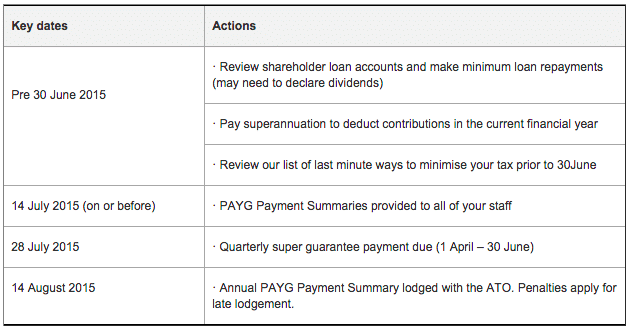
Here’s our list of the top things you need to do and review before 30 June arrives:
1. Write-off bad debts. To be a bad debt, you need to have brought the income to account as assessable income, and given up all attempts to recover the debt. It needs to be written off your debtors’ ledger by 30 June. If you don’t maintain a debtors’ ledger, a director’s minute confirming the write-off is a good idea.
2. Trading Stock. Write off any stock that is damaged or obsolete. Complete a stock take (if you are not using the simplified trading stock rules) and remember that stock can be valued at the lower of cost, replacement, or net realisable value. You can use different methods for different stock items.
3. Review your asset register and scrap any obsolete plant. Check to see if obsolete plant and equipment is sitting on your depreciation schedule. Rather than depreciating a small amount each year, if the plant has become obsolete, scrap it and write it off before 30 June. Small Business Entities can choose to pool their assets and claim one deduction for each pool. This means you only have to do one calculation for the pool rather than for each asset. It also allows you to claim an immediate deduction for depreciating assets that are bought for less than $1,000.
4. Repairs, consumables (office stationery etc), trade gifts or donations. To claim a deduction for the 2014/2015 financial year, consider paying for any required repairs, replenishing consumable supplies, trade gifts or donations before 30 June.
5. Pay June quarter employee super contributions if you want to claim a tax deduction in the current year. The next quarterly superannuation guarantee payment is due on 28 July 2015. However, some employers choose to make the payment early to bring forward the tax deduction instead of waiting another 12 months.
6. Superannuation. Don’t forget yourself. Superannuation can be a great way to get tax relief and still build your wealth position. Your personal or company sponsored contributions need to be received by the fund before June 30 to ensure deductibility.
7. Capital gains and losses. Neutralise the tax effect of any capital gains you have made during the year by realising any capital losses that you have. These need to be genuine transactions in order to be effective for tax purposes. It may be possible to contribute assets with unrealised losses to superannuation in order to do this.
8. Directors’ fees and bonuses. Declare them before 30 June and providing the company is absolutely committed to them, you are entitled to the deduction even if they have not been paid. Again, a director’s minute is a good idea. The directors and employees only need to declare this income in the year of receipt although they need to be formally notified of their entitlements by 30 June.
9. Management fees. Where management fees are being charged between related entities, make sure that the charges have been raised by June 30. Where management charges are used, make sure they are commercially reasonable and there is documentation to support this position. If any transactions are being undertaken with international related parties then the transfer pricing rules need to be considered and the ATO’s expectations in relation to documentation will be much greater. This is an area that the ATO are placing under greater scrutiny.
For Your Business
Trustees must make a decision on distributions by 1 July
Trustees need to decide on distributions of trust income by 30 June (at the latest) to ensure that beneficiaries are presently entitled to trust income for tax purposes. Trustees used to have until 31 August to make a decision but this administrative concession has been removed. If the ATO is not satisfied that the resolutions have been made in time then the risk is that the trustee or default beneficiary will be taxed on all of the trust income.
Defer your income
If possible, defer your income until the new financial year. In particular this can work for service based businesses or where you are billing your clients on a progress payment basis. Make sure that you can manage any cash flow effects that come with this one.
Manage your capital gains and losses
Remember that capital gains trigger on the date of the contract not the date of payment. Also, capital losses can only be written off against capital gains. So, if you are selling assets that will trigger a capital gain try and delay the contract until 1 July unless you have some capital losses that you are able to offset against.
Please contact either John, Rob or Sam, if you would like further information.